
Interchange formats flatten your work into a mesh. The .clay file is the opposite: Re:Form's native project format, a snapshot of the whole session — every layer with its name and order, paint and masks, your per-brush settings, reference images with their placement, and your viewport setup. Open it later and you're back exactly where you stopped.
Saving
- File ▸ Save .clay — save to the file you're working in.
- File ▸ Save .clay as… — save under a new name.
The file downloads to your machine like any browser download. It's yours — put it in a project folder, back it up, send it to another computer, and open it there.
Opening
File ▸ New opens the Projects window — the same browser the start screen shows:
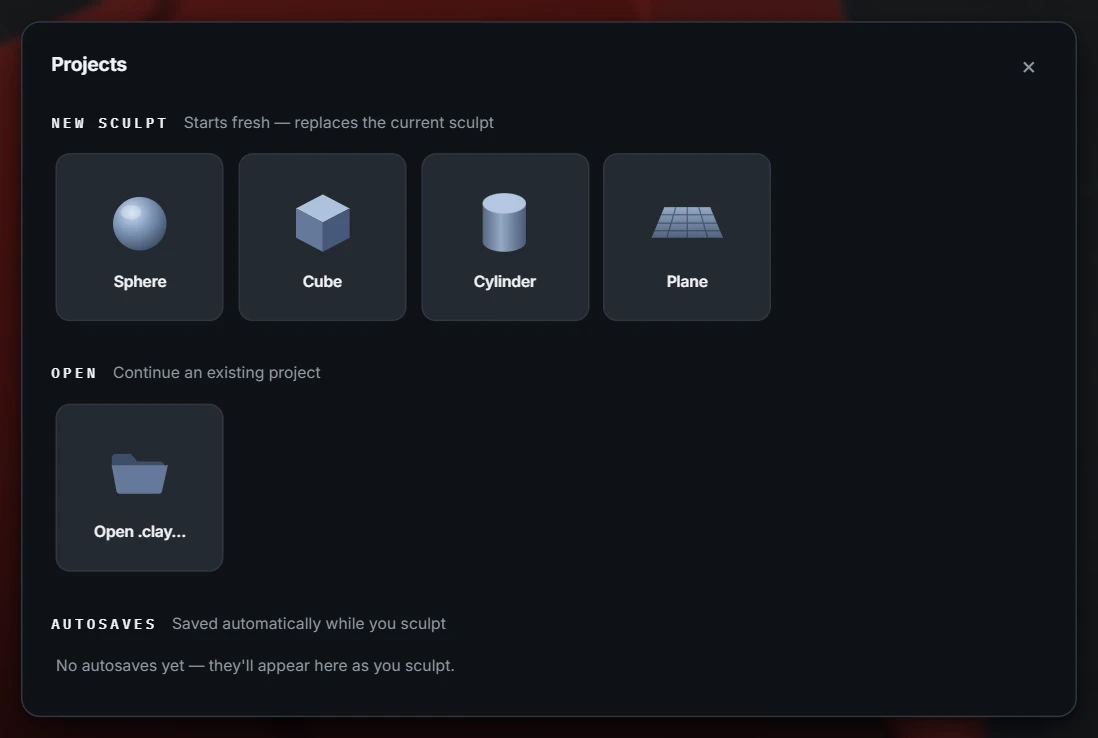
- New sculpt — start over from a Sphere, Cube, Cylinder or Plane (this replaces the current sculpt — save first).
- Open — load a
.clayfrom disk. - Autosaves — the dated snapshots below.
Autosave
While you work, Re:Form keeps rotating snapshots in the browser's own storage — up to eight dated slots, each with a thumbnail, newest replacing oldest. Closed the tab mid-session? Browser crashed? Open the app again and the autosaves section has your recent state waiting.
Two habits keep autosave in its proper place:
- Autosave is the safety net, not the archive. It lives in this browser on this machine, and browsers can clear their own storage. Anything you care about gets a real Save .clay.
- Save before destructive milestones — before a big remesh, before merging layers, before "just trying something". Undo is deep, but a named file is certainty.
`.clay` keeps working data that exports can't carry — layers stay separate, masks stay live, brushes stay tuned. Treat it like a project file in any serious tool: .clay to work, OBJ/STL/GLB/FBX to ship.