
Screenshots show your viewport; renders show your sculpt. The Render menu produces presentation-quality output — supersampled stills with studio lighting and ambient occlusion, and looping turntable videos — without the scaffolding (grids, guides, cursor) that lives in the working view.
Render image…
Render ▸ Render image… opens the render dialog. The framing is exactly what your viewport shows, and the preview is a true preview — a real render at thumbnail size through the identical pipeline, so it can't lie about the result. Drag the preview to orbit, right-drag to pan, wheel to zoom — or click it to refresh.
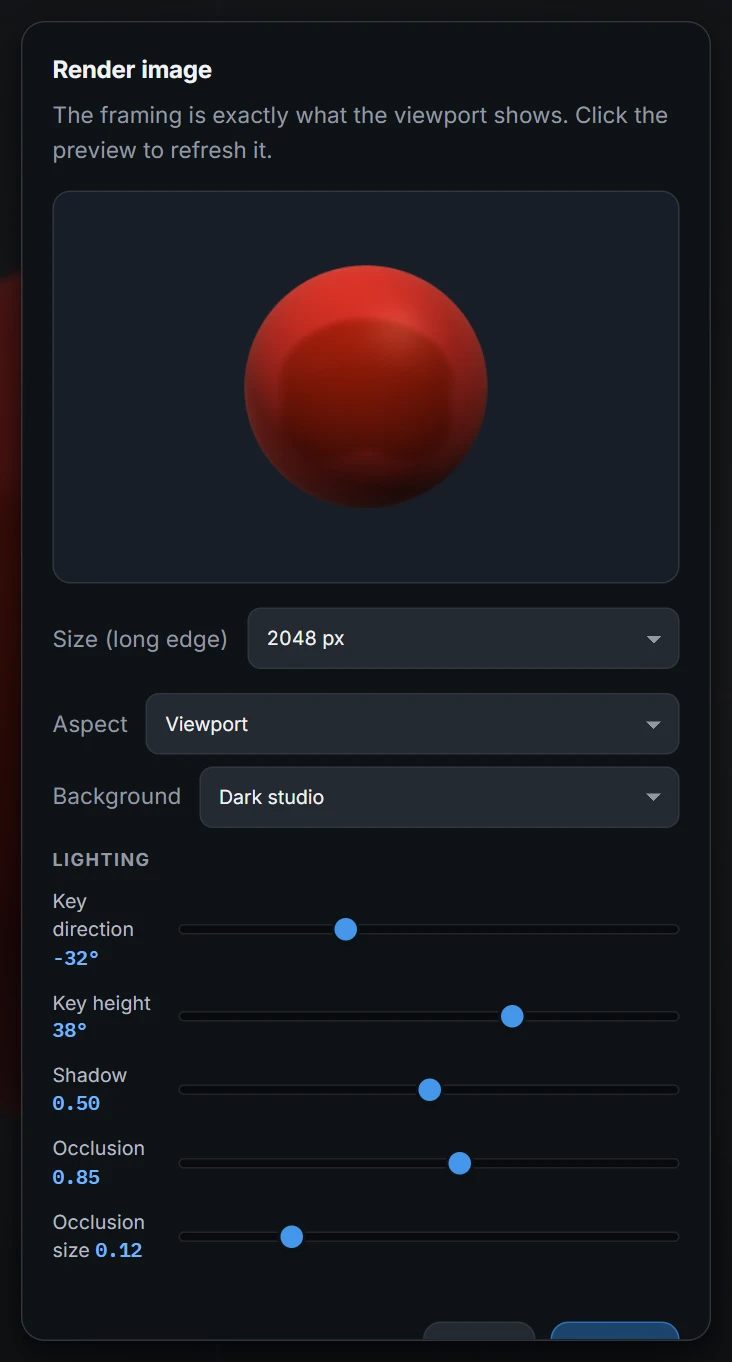
The options:
- Size — 1024 or 2048 pixels on the long edge, or 4096 Pro.
- Aspect — match the viewport, or render an exact ratio: square, 4:3, 3:4, 16:9, 9:16.
- Background — the dark studio, transparent (for compositing anywhere), black, white, any solid colour, or a two-colour linear/radial gradient.
- Lighting — the render's own key light (direction and height), Shadow strength, and screen-space Occlusion (strength and size) — the contact shading that makes forms sit into themselves.
Press Render, and the finished image opens in a result dialog — name it and save. Renders respect your shading mode: Matcap renders the sculpt look; Lit renders your painted materials under the light rig.
Render turntable… Pro
Render ▸ Render turntable… renders one full revolution around the sculpt as a looping video, from the current view — the classic way to show a sculpt online.
- Size — 512, 1024 or 2048 pixels.
- Length — 4, 6 or 8 seconds for the revolution.
- The same aspect, background and lighting controls as stills, shared between both dialogs.
The result saves as an MP4 (H.264) that posts anywhere video does.
Your render settings — aspect, background, lighting — persist with the project, so re-rendering after another sculpting session picks up the exact same look.